



In 2022, the European Parliament adopted the Directive on Gender Balance on Corporate Boards (Gender Balance on Corporate Boards Directive), which stipulates that large listed companies must ensure that at least 40 per cent of the under-represented gender are represented on their supervisory boards and that 33 per cent of all directors are from that gender by June 2026. Our analysis of European listed companies, based on BoardEx data from 2024, reveals a sobering reality: only those countries that have already introduced the most ambitious gender quotas are currently meeting these targets.
Research consistently shows that the design of the quota is more important than the quota itself. Countries with strict enforcement mechanisms and supportive institutional frameworks achieve better results in terms of gender representation on boards than countries with weaker measures (Mensi-Klarbach & Seierstad, 2020). The Directive on gender parity on company boards (2022/2381) sets these binding targets with a deadline of 30 June 2026. However, the Directive leaves the enforcement mechanisms to the individual Member States, which may lead to inconsistencies in implementation across the EU.
To assess the current state of implementation, we analysed the Member States on the basis of their existing gender quota regulations. Our analysis uses a broader sample than the scope of the Directive: we examined all listed companies in the BoardEx 2024 database, regardless of their size, whilst the EU Directive applies only to large companies that exceed certain thresholds for the number of employees and total assets. This means that our findings also include smaller listed companies that may not be subject to the requirements of the Directive.
Further details can be found in the ‘Methodology and Data’ section at the bottom of this page.
We have categorised the countries according to their quota targets. Following Kirsch (2021), quotas below 40 per cent are regarded as ‘tilted measures’ – initial steps towards gender parity – whilst targets of 40 per cent or more indicate genuine gender parity. As the Directive sets out targets but no enforcement mechanisms, an analysis of existing national measures provides valuable insights into the likelihood of implementation.
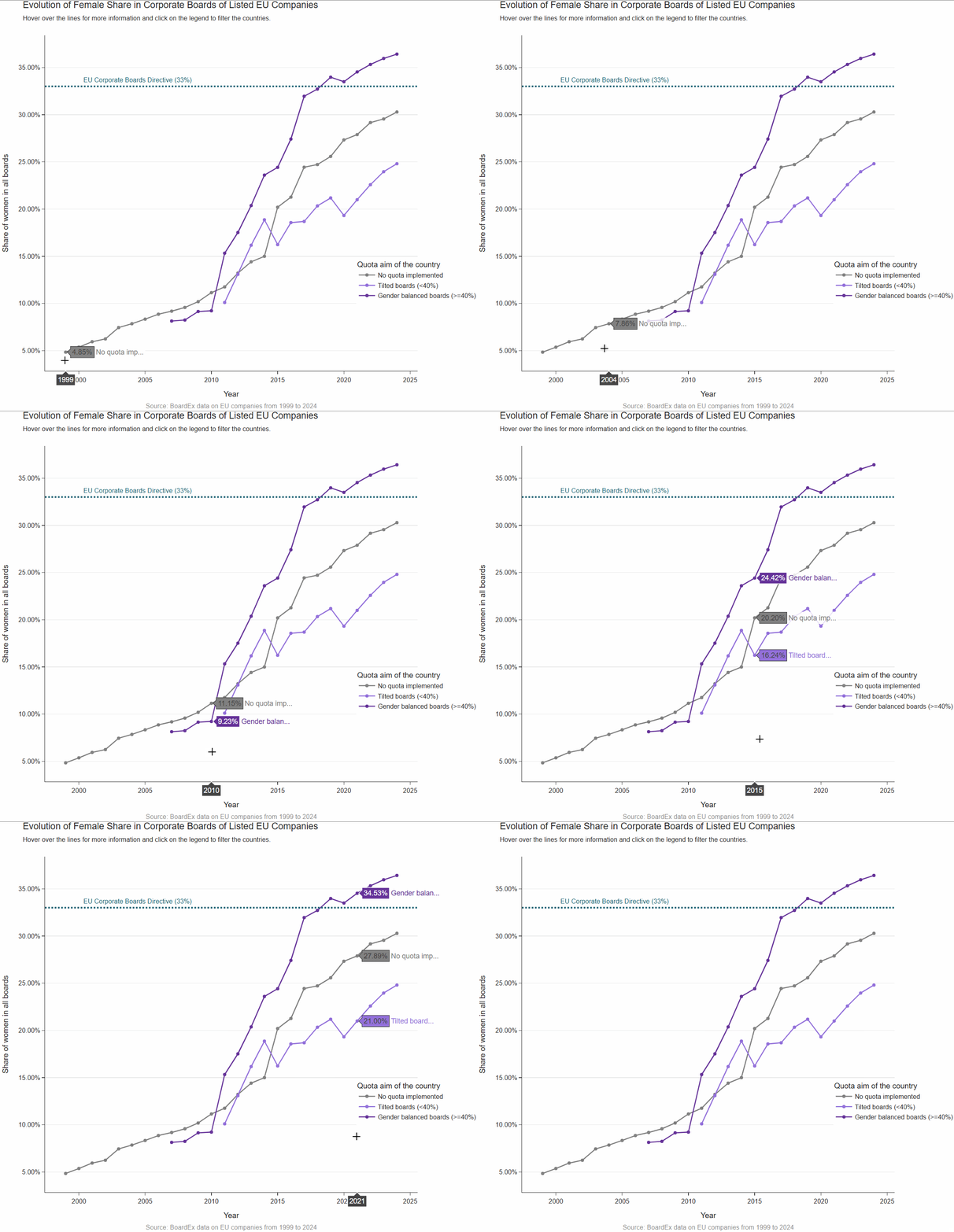
Interactive version available here
Our findings reveal a clear pattern: companies in countries with the most ambitious quota targets (40 per cent or more) are already exceeding the requirements of the EU Directive and, on average, exceed the 33 per cent threshold. Countries with moderate quotas (39 per cent or less), by contrast, perform worse than expected, whilst countries without formal quotas show mixed results – some, surprisingly, outperform the group with moderate quotas. These findings are consistent with existing research: the effectiveness of quotas depends heavily on the context in which they are implemented, not solely on the numerical target.
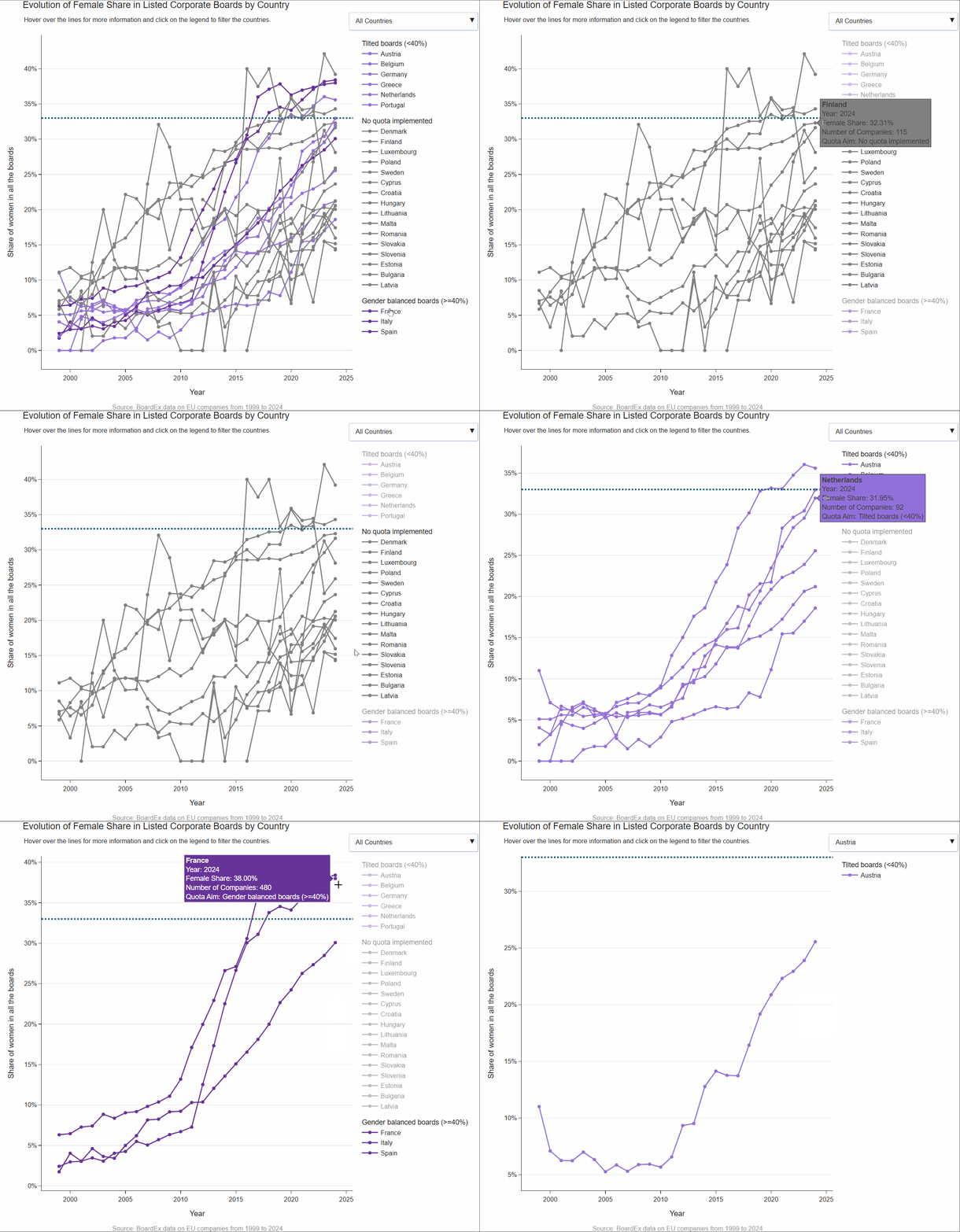
Interactive version available here
Analysis at country level reveals some key characteristics. Despite ambitious targets for gender parity, Spain falls short of the requirements of the Directive. Portugal, Belgium and the Netherlands, on the other hand, are approaching the threshold, even though they have set only moderate targets, whilst other countries lag significantly behind in their respective categories.
Countries without formal quotas can nevertheless promote diversity on boards through other mechanisms. The Nordic countries (Sweden, Denmark and Finland) illustrate this approach: they are approaching the Directive’s target values, presumably due to strong institutional frameworks promoting gender equality, as noted by Mensi-Klarbach & Seierstad (2020).
Our findings underline the importance of a context-specific analysis. Higher quota targets alone do not guarantee better results – the implementation context proves to be decisive. Furthermore, some countries have very few listed companies (Bulgaria: 3, Latvia: 1 in 2024), which raises questions about the practical impact of the Directive in smaller markets. Many of these companies may not meet the size thresholds (EU Directive on company sizes) above which the Directive’s requirements apply – which highlights the importance of understanding how gender equality in corporate governance develops in different market contexts.
In any case, the Directive is intended to generate momentum and place legislation promoting gender equality on company boards on the agenda of Member States. It is expected that each country will adapt the legislation to its own context.
Finally, it should be noted that in January 2025, the European Commission sent formal letters of notice to Belgium, the Czech Republic, Estonia, Greece, Cyprus, Latvia, Luxembourg, Hungary, the Netherlands, Austria and Romania in January 2025.
Methodology and data
The analysis uses European company data from BoardEx, which covers listed companies as well as selected private companies that publicly disclose their board composition (more on BoardEx data and processes).
We have filtered the data to include only the 27 EU Member States, focusing on companies with an active ticker symbol that were not marked as delisted. Our analysis includes only companies with data for 2024 and tracks their board composition from their first appearance in the database.
The calculation of board composition takes into account all directors who served on any board (supervisory or executive) in a given year. We calculated the proportion of women based on the total board membership for each company and year.
Bibliography
Left unchanged from the original (authors, titles and journal details are not translated in academic reference lists):
Kirsch, A. (2021). Women on Board Policies in Member States and the Effects on Corporate Governance. Commissioned study by the Policy Department for Citizens’ Rights and Constitutional Affairs, Directorate-General for Internal Policies. https://www.europarl.europa.eu/RegData/etudes/STUD/2021/700556/IPOL_STU(2021)700556_EN.pdf
Mensi-Klarbach, H., & Seierstad, C. (2020). Gender Quotas on Corporate Boards: Similarities and Differences in Quota Scenarios. European Management Review, 17(3), 615–631. https://doi.org/10.1111/emre.12374